Inkindly: validation journal for an app I haven't coded yet
The full Inkindly journal: idea hunting, Tally landing, Calendly interviews, Insta and Reddit accounts, karma farming, and why I dropped it after two weeks.
Honest post-mortem. Started as a validation journal, ended as an owned-up shutdown. Last edited: 27 April 2026.
Where the idea comes from
Several people close to me told me, a few weeks apart, about the same hassle: their skin reacting to a cosmetic product without being able to point to which specific ingredient is responsible. The "try it, drop it, try again" routine can take months. When the same problem keeps coming back in unrelated conversations, it's worth paying attention.
Working hypothesis: an app that lets you scan the products you use, log your reactions, and over time surfaces the ingredients that keep showing up when things go wrong.
Why I'm not coding yet
For a long time my first reflex was: "OK, I sense a problem, I'll build it." Except shipping a scan, journal and ingredient cross-referencing app is several weeks of full-time work. Before I commit, I want to know if:
- The problem is shared beyond my immediate circle
- People would actually try the app
- Anyone would be willing to pay for it
So before the POC, data. Three questions to validate, each with its indicator:
| # | Question | What it measures | How I read it |
|---|---|---|---|
| 1 | Does the promise resonate, yes or no? | Raw desirability | Email signup rate over views |
| 2 | How much would the person pay? | Willingness to pay | Distribution of selected tiers |
| 3 | Who agrees to a 15-min call? | Deep engagement | Number of interviews booked |
The validation landing
I shipped a single-page landing at inkindly.lioncore.dev. Deliberately minimal stack: Next.js 16, Tailwind v4, deployed on Vercel. No DB, no auth, no complex feature to maintain. The only real interactive piece is an embedded Tally form that asks the three questions above.
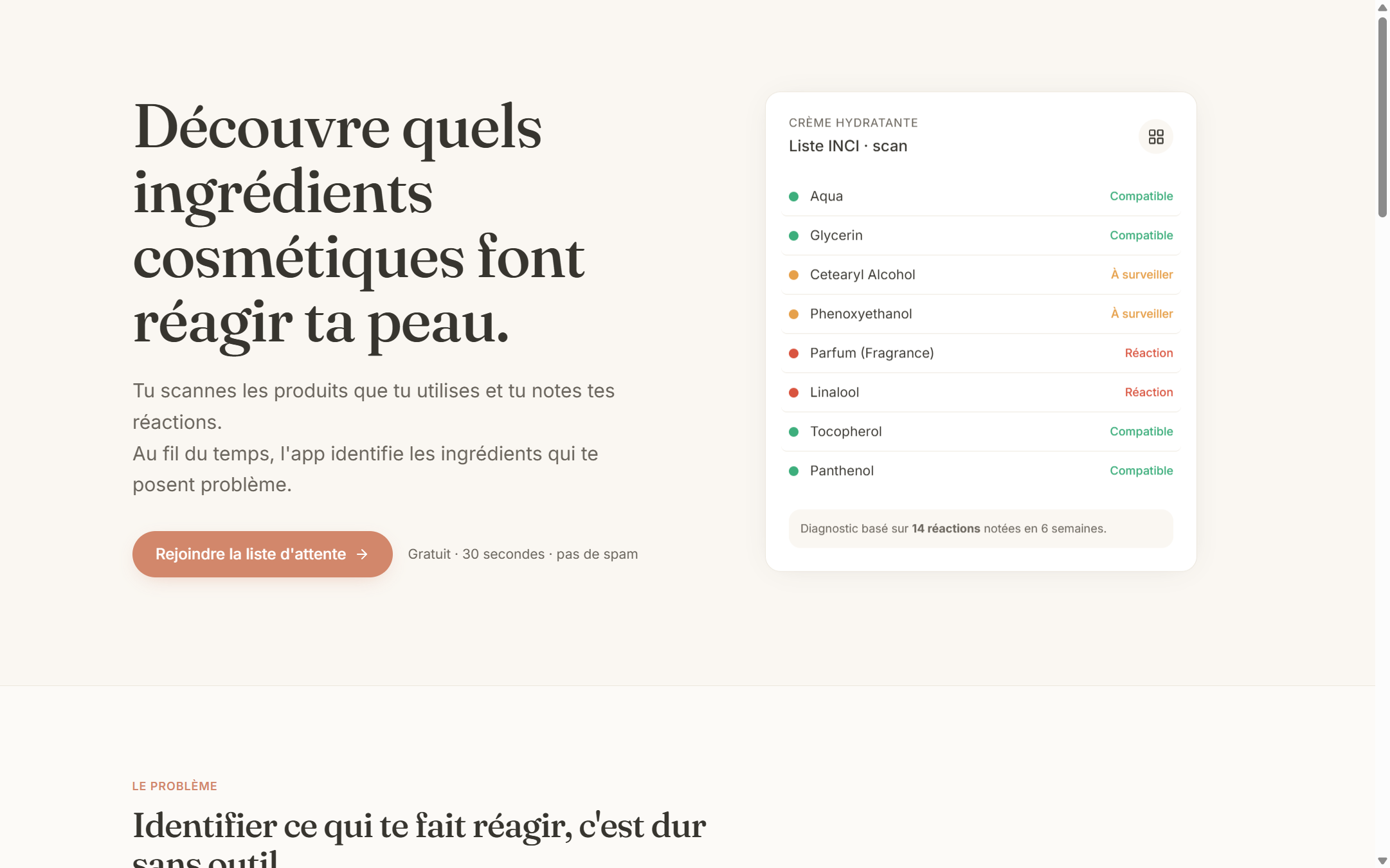
Explicit tech choices:
| Decision | Alternative ruled out | Why |
|---|---|---|
| Tally | Custom form | Zero backend, CSV exports, GDPR handled for me |
| Plausible | Google Analytics | Cookieless, so no consent banner |
| No bitmap images | Illustrated hero | Mobile Lighthouse > 95 without fiddling |
If I have to pivot in three weeks, I have no debt to clean up.
Calendly for user interviews
The form has a checkbox "OK for a 15-min call". People who check it get a Calendly link with evening slots open. Target: 8 to 10 interviews over the next two weeks.
What I'm looking for in an interview, in priority order:
- Understanding the current journey, without imposing my solution
- Identifying the workarounds they already use (Yuka, INCI Beauty, manual lists, etc.)
- Measuring concrete frequency: how many times a month is this a problem?
- Testing the app's promise verbally and noting natural reactions
I don't sell anything during the call. The moment I start pitching, I bias everything.
Going to where people already are
A landing on its own doesn't generate traffic. So I started posting, soberly, in the places where the topic already lives:
- Cosmetic and reactive-skin forums and subreddits (FR + EN)
- Facebook groups dedicated to sensitive skin
- A few targeted DMs to contacts who had specifically mentioned the problem
The rule I'm sticking to: no spam, one post per community, openly explaining I'm in research mode and need feedback. The form stays optional. Several moderators validated the approach precisely because I'm not selling anything.
Standing up the Insta and Reddit accounts
To exist where the audience hangs out, I created two dedicated Inkindly accounts:
- Instagram, because reactive skin and cosmetics live heavily through visuals
- Reddit, because the skincare and sensitive-skin subreddits are full of raw stories and ingredient-level questions
On both, I started posting simple stuff: photos of INCI labels, open questions like "do you log your skin reactions anywhere?", anonymised takeaways from interviews. Nothing promotional, just raw material to get going.
Reddit has a brutal quirk: a brand-new account that posts in a topical subreddit gets near-instantly banned by anti-spam filters (low karma, young account, external link). To be allowed to post, you first have to exist:
| Step | What I did | Why |
|---|---|---|
| 1. Set up the accounts | Clean bio, photo, lioncore link | Send a "human" signal rather than a "bot" one |
| 2. Build base karma | Replied 20–30 times on existing posts in the target subs, with genuinely useful answers | Get above the moderators' auto-ban threshold |
| 3. Read each sub's rules | Read every sub's specific rules before posting | Avoid manual bans (no links, mandatory format, etc.) |
| 4. First post | Question or testimonial format, no link in the body | Maximise the chance of clearing moderation |
I spent several evenings genuinely replying to skincare threads to push the counter up. Karma rose slowly. That's where it started to break for me.
Why I dropped the project, two weeks in
At that point the experiment was working. A few interviews were booked, the form was getting answers, the first Reddit posts weren't getting instantly banned anymore. But I stopped.
The topic just doesn't grab me. I don't have reactive skin, I have zero cosmetics knowledge, I can't read an INCI list without checking Yuka. Every time I forced myself to post on Insta or reply on r/SkincareAddiction, I was bored. An indie project where you're bored at week two has no chance of surviving month six.
The distribution cost would be huge. For Inkindly to reach the people who'd actually need it, I'd have to become, in practice, a cosmetics Insta account and a regular Reddit skincare poster. That's a full-time community-management job in a domain that isn't mine.
And on top of that, I got scared. Scared that this work, sustained, would eventually kill my taste for building apps. My craft, my fun, my edge: building the product. Not running ads. Not growing social accounts in a niche I don't relate to. If I force myself to play cosmetics marketer for six months for the app to take off, I lose the very thing that made me start the project.
I'm not a marketing guy. I'm an app guy.
I know Inkindly could help people, the form is enough proof of that. But helping people through a product I don't carry, in a domain where I'm not legitimate, by spending the energy I have for building things… the math doesn't work.
The bigger lesson: with AI, plan BEFORE you produce
The other real lesson from these two weeks is about how I work with AI. The temptation, when you've got Claude or GPT at hand, is to jump straight into producing: open Reddit, create the account, generate the bio, ask for a banner, pick a color, launch the landing, write the copy, code a slice of the app… all in the same evening.
I lived the result: it turns into a mental labyrinth. Every step opens three sub-questions, every sub-question opens three micro-decisions, and the AI answers each one instantly. You move fast, but with no clear direction.
A concrete example of that spiral, lived this month:
Socials → OK, which ones? → Reddit → need a banner → which tool to generate it? → what art direction? → which color palette? → consistent with the landing or standalone? → wait, is the landing's palette even defined? → maybe I should redo the landing first… → three hours later, I have no banner, no post, no finished landing.
Each arrow is legitimate, but the chain has no plan. With an AI that executes in real time, the friction that used to force me to think before producing is gone, and with it a guardrail I was using without realising it.
What I should have done, and will do on every project from now on:
| Before launching any execution | Why |
|---|---|
| List every concrete deliverable (landing, social accounts, banners, posts, app, form) | See the real scope before diving in |
| Detail each step leading to that deliverable, item by item | Stop the drift into "child questions" |
| Decide upfront: art direction, palette, tone, format, audience, channels | The AI won't decide that for you: it executes |
| Set an order and a definition of "done" for each step | Without a stopping rule, you iterate forever |
AI brutally speeds up production. But it doesn't speed up thinking. If I haven't planned each piece beforehand, I spend the speed gain fixing choices made on the fly. The upfront plan isn't extra slowness, it's what lets you actually cash in the AI speed gain.
With AI, the plan isn't optional anymore: the plan is what makes the tool pay off.
What I'm taking forward
No regrets, just a tighter filter for the next idea:
| Criterion | Before Inkindly | After Inkindly |
|---|---|---|
| Personal interest in the topic | "Eh, I'll learn" | Without strong interest, I don't start |
| Legitimacy in the domain | "Doesn't matter, I'll find people" | Without baseline knowledge, I burn out |
| Natural distribution channel | "I'll figure it out later" | If it requires becoming a different kind of creator, I don't start |
| Joy in the distribution effort | Ignored | Measured at idea stage |
The cost of an indie project isn't just technical. It's emotional, and it lasts months. Inkindly's validation cost me two weeks instead of six months. That's exactly what the validation phase is supposed to do.
The landing stays online
I'm leaving inkindly.lioncore.dev up and the form open. If someone with more legitimacy on the topic and more comfort with the community-building side wants to pick the idea up, drop me a line and I'll happily hand over what I have.